Sarvodaya
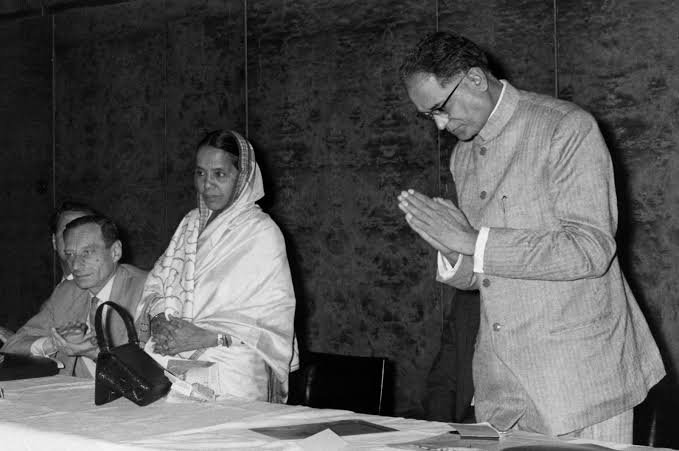
Jayaprakash Narayan’s intellectual journey gradually took him from Marxism and socialism towards Gandhian Sarvodaya. His disillusionment with Soviet Communism deepened as he witnessed the Moscow Trials, Stalinist repression, rigid party discipline and the suppression of dissent. He came to believe that excessive centralisation of power and uncompromising party control inevitably threatened individual freedom and democracy.
"After Independence, JP increasingly turned towards Gandhi, discovering in non-violence, the unity of means and ends, morality, individual freedom and decentralisation a more humane path to social and economic transformation. He concluded that socialism, despite its promise of freedom, equality, fraternity and peace, could not realise these ideals unless it evolved into Sarvodaya—the upliftment of all."
Sarvodaya rejects the Marxist idea of class struggle and instead emphasises class cooperation, seeking to replace the “politics of power” with a “politics of cooperation and reconciliation.” Its approach to economic equality also differed fundamentally from coercive redistribution. Through Gandhi’s principle of Trusteeship, property owners were encouraged to regard their wealth as a trust for society and use it for the welfare of the community.
JP increasingly saw Sarvodaya as a practical and ethical alternative to both state-controlled communism and conventional socialism. He found a living example of this approach in Vinoba Bhave’s Bhoodan Movement, launched in 1951, which sought voluntary land redistribution through moral persuasion rather than legislation or violence. The movement’s early success, including the voluntary donation of land by landlords, convinced JP of the transformative potential of voluntary social action.
His commitment culminated at the Sarvodaya Conference at Bodh Gaya in 1954, where he took the pledge of Jeevandan (Gift of Life), deciding to devote the rest of his life to Sarvodaya and Bhoodan. He gave up electoral politics and declined Jawaharlal Nehru’s invitation to join the Union Cabinet. Thereafter, JP chose the path of a grassroots social worker, travelling across India, mobilising voluntary land donations and working among the rural poor.
Thus, JP’s journey from socialism to Sarvodaya represented a fundamental shift—from transforming society through political power and structural change to transforming it through non-violence, moral persuasion, voluntary cooperation and decentralised social action. For him, genuine social transformation had to emerge from within society rather than be imposed upon it by the State.
Thoughts on Democracy
Jayaprakash Narayan believed that democracy loses its true meaning when politics becomes driven by unethical means, the pursuit of power and partisan interests. He was particularly critical of the growing dominance of political parties, arguing that modern democracy was increasingly becoming a “party system”, where competition for power could foster corruption, division and the erosion of democratic values.
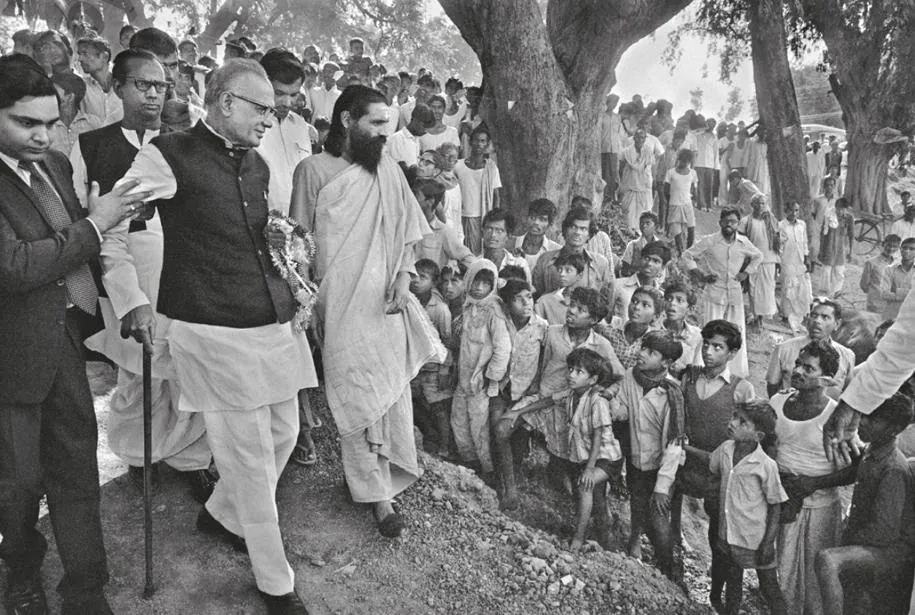
JP felt that representative democracy often reduced citizens to the limited role of electing and removing governments, leaving important decisions largely in the hands of an elected political elite. He described this tendency as an “elected oligarchy.” Yet he did not reject parliamentary democracy or advocate authoritarian alternatives. Instead, he sought to make democracy more participatory, decentralised and directly connected with citizens.
His alternative was a vision of partyless, consensus-based democracy rooted in local self-government. He proposed a three-tier structure beginning with Gram Sabhas and Nagar Sabhas, where all adult citizens would participate directly. These grassroots bodies would elect Panchayat Samitis at the block level, which would in turn elect Zila Parishads at the district level. Representatives to the State Legislatures and Lok Sabha would emerge through this decentralised electoral structure.
Decentralised Democratic Structure
By placing decision-making closer to the people, JP believed that politics could become less personality-driven and less dominated by party ideology. When citizens deliberated directly on issues affecting their own communities, local needs and public interest could take precedence over partisan interests.
Ultimately, JP sought to transform politics into “Lokneeti”—people-centred politics—and democracy into a system grounded in participation, decentralisation, consensus and social cooperation. His vision was not simply to change who governed, but to fundamentally change how people participated in governance, making democracy a continuous process of popular involvement rather than an activity confined to periodic elections.
Total Revolution ( Sampoorna Kranti )
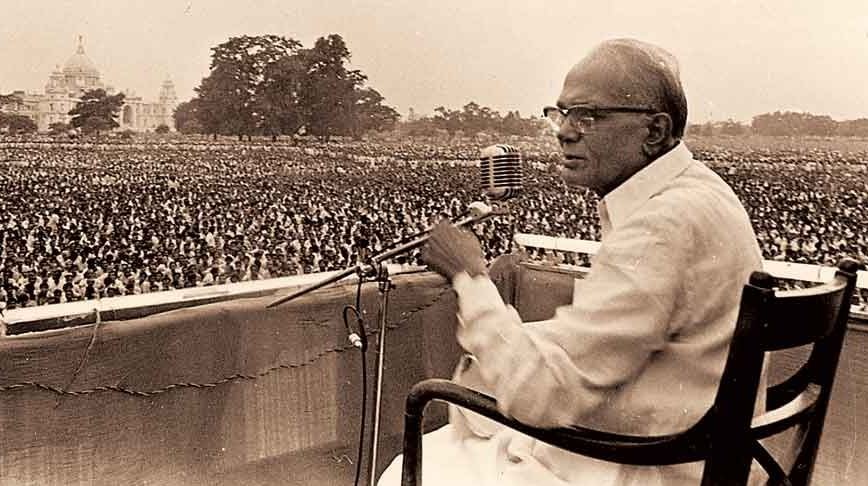
Total Revolution was Jayaprakash Narayan’s final major ideological intervention, aimed at transforming India into a democratic, decentralised, participatory, egalitarian and morally grounded society. The idea had earlier been articulated by Vinoba Bhave, but JP developed it into a comprehensive programme for national transformation and, in 1975, called upon the people to rise for Total Revolution.
JP believed that India’s problems could not be solved through piecemeal reforms. The distortions in public life required transformation across social, economic, political, educational, cultural and spiritual spheres. At its core, Total Revolution sought to restore the ethical values of Sarvodaya to public life and create institutions that were genuinely responsive to the people.
A central concern was the concentration of political and economic power. JP believed that excessive centralisation could make democratic institutions corrupt, authoritarian and unresponsive. He therefore advocated decentralisation and the transfer of meaningful power to ordinary citizens, along with electoral reforms that would free democracy from money power, coercion and corrupt influence.
His vision extended to the economic sphere as well. JP supported a mixed economy but wanted it reorganised to guarantee every person the basic necessities of food, clothing and shelter. Inspired by Gandhi’s principle of Trusteeship, his idea of Sampattidan (gift of wealth) encouraged those possessing wealth and resources to share them for the larger social good.
Total Revolution also demanded the removal of caste and religious discrimination, reduction of social inequality and the reform of institutions that had become disconnected from popular aspirations. In the political context of 1975, JP called for resistance to the increasingly authoritarian policies of the government and demanded the dissolution of State Legislative Assemblies that he believed no longer reflected the genuine will of the people.
Yet Total Revolution was not simply a movement to replace one government with another. Its deeper objective was to transform both institutions and citizens. JP believed that lasting change required an aware, politically conscious and ethically responsible citizenry. He therefore sought not merely a change in the holders of power, but a transformation in the nature, purpose and distribution of power itself.
Importantly, JP rejected both interpretations of Total Revolution as the abolition of the State and attempts to achieve change through violence. He clarified that political power was not to be eliminated but returned to its rightful source—the people. And consistent with his Gandhian transformation, Total Revolution could only be achieved through peaceful, non-violent and voluntary mass participation.
In essence, Total Revolution represented the culmination of JP’s intellectual journey—from socialism to Sarvodaya and from the politics of power to the politics of people’s participation. It sought to transform India not merely by changing governments, but by changing the social order, institutions, distribution of power and moral foundations of public life.
Thoughts on Socialism
Jayaprakash Narayan emerged as one of modern India’s foremost socialist thinkers. His understanding of socialism was shaped as much by his personal experiences as by his intellectual engagement with Marxism. During his nearly seven years in the United States as a student, he worked among immigrants and workers and witnessed poverty, racial discrimination and economic inequality at close quarters. These experiences made him deeply sensitive to social injustice and convinced him that political freedom could have little meaning without social and economic freedom.
His exposure to Marx, Engels, Lenin, Trotsky, Plekhanov and M. N. Roy further strengthened this conviction. For JP, freedom was not merely freedom from colonial rule or the right to participate in politics. It also meant freedom from poverty, hunger, exploitation and deprivation—the conditions necessary for people to live with dignity and realise their full potential.
Yet JP’s engagement with Marxism was never uncritical. He was deeply attracted to its concern for economic equality and social justice, but remained uncomfortable with its violent, centralized and authoritarian forms. The suppression of political freedoms under the Soviet model reinforced his belief that socialism without democracy could not deliver genuine freedom. His commitment to democratic and non-violent transformation eventually brought him closer to Gandhi and the method of Satyagraha.
At the heart of JP’s early socialist thought was the belief that economic inequality is largely structural. People may differ in their natural abilities and talents, but vast differences in wealth and opportunity cannot simply be attributed to these differences. They are rooted in unequal control over property, resources and the means of production. Unless these structural inequalities were addressed, individuals could not enjoy a genuinely equal opportunity to develop their capabilities.
JP therefore regarded economic security and the fulfilment of basic needs as the foundation of a meaningful and creative life. A person struggling constantly for food, shelter or employment could hardly be expected to participate fully in the cultural, intellectual and social life of the nation. Economic restructuring was consequently central to his vision of a just society.
At the same time, JP resisted the idea that socialism was merely a Western doctrine to be transplanted into India. He argued that while socialism had acquired its modern theoretical and economic form in the West, many of its underlying ethical values—equality, cooperation, sharing, social justice and collective welfare—had long been present in Indian thought. The Indian tradition, he believed, had never regarded limitless accumulation, excessive consumption or unrestrained greed as ideals.
JP thus sought to develop a distinctly Indian socialism—one that combined the economic concern for equality with India’s traditions of restraint, cooperation and collective welfare, while remaining firmly rooted in democracy and individual freedom. For him, socialism was ultimately not merely a method of redistributing wealth, but a broader ethical and democratic vision of social transformation, aimed at creating a society in which freedom, equality and human dignity could coexist.